


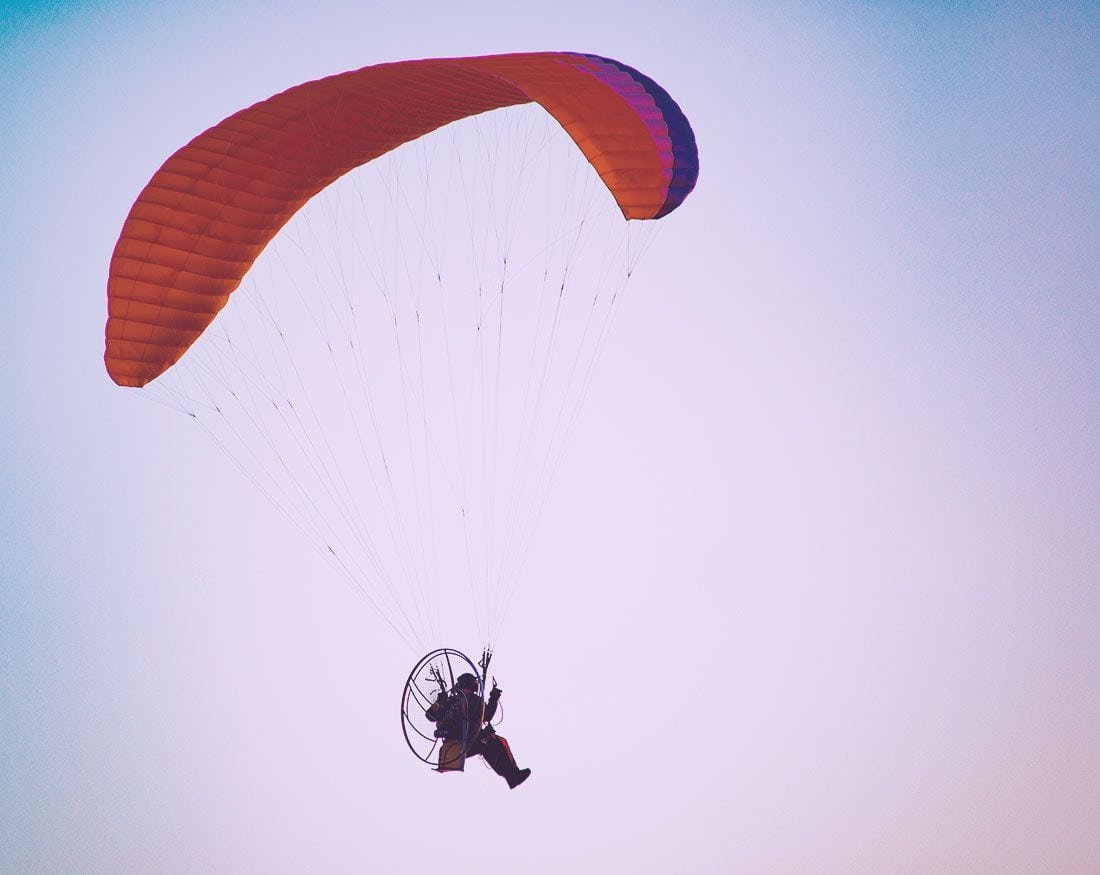
24 Jul Powered Paragliding, Paramotoring and Paratrike: What Each One Is
The three names get used as though they were three different machines, and they are not. Powered paragliding and paramotoring are the same thing under two names. A paratrike is genuinely different, but not because of the engine, because of where the engine is mounted.
Powered paragliding and paramotoring are the same thing
Powered paragliding is the name of the discipline, and paramotoring is its exact synonym. Strictly speaking, the word paramotor names neither the activity nor the whole aircraft, but the engine: the unit with propeller and cage that the pilot wears on their back. Which is why it ends up standing for both.
The wing, incidentally, is a paraglider wing. Reinforced, and sometimes with a slightly different profile, but the same kind of wing.
What actually changes is how the engine is carried
On your back. The pilot puts the engine on like a rucksack, runs a few metres and takes off. This is the lightest and most portable form, it fits in a car boot, and it flies one person.
On a paratrike. The same engine and the same wing, mounted on a wheeled chassis much like a tricycle. It rolls into the air instead of running, so nobody has to carry the weight of the engine, it takes more load and it can carry a passenger. In exchange it needs flat, clear ground, and it cannot be carried on your shoulders.
That is the real difference, and it explains what each is used for. The paratrike where weight or a second person has to be carried. The back-mounted one where you have to walk in.
Neither of them is an unpowered paraglider
A free-flight paraglider takes its height from the air. It needs thermals or a slope with wind on it, and it does not fly when the air gives nothing. A powered machine takes its height from fuel, so it can fly in still air and from flat ground, which is exactly what free flight cannot do.
In exchange it is neither as quiet nor as cheap, and above all it is not in the same category. Powered flight sits in ultralight aviation, with its own licence and its own requirements, separate from those of free flight. The details vary from country to country, so the thing to do is check with the relevant national federation.
What is flown at Enminube is not this
Every Enminube flight is free flight. No engine, no propeller and no fuel, which means the height comes from the air and the terrain, and that is why the site and the time of day matter as much as they do. How that works is covered in what is paragliding.
And one thing worth clearing up, because it is often confused. Flying with reduced mobility does not require a paratrike. Enminube’s adapted flights are unpowered tandem flights, flown from every site except Arafo, under the same conditions and for the same length of time as any other flight.